
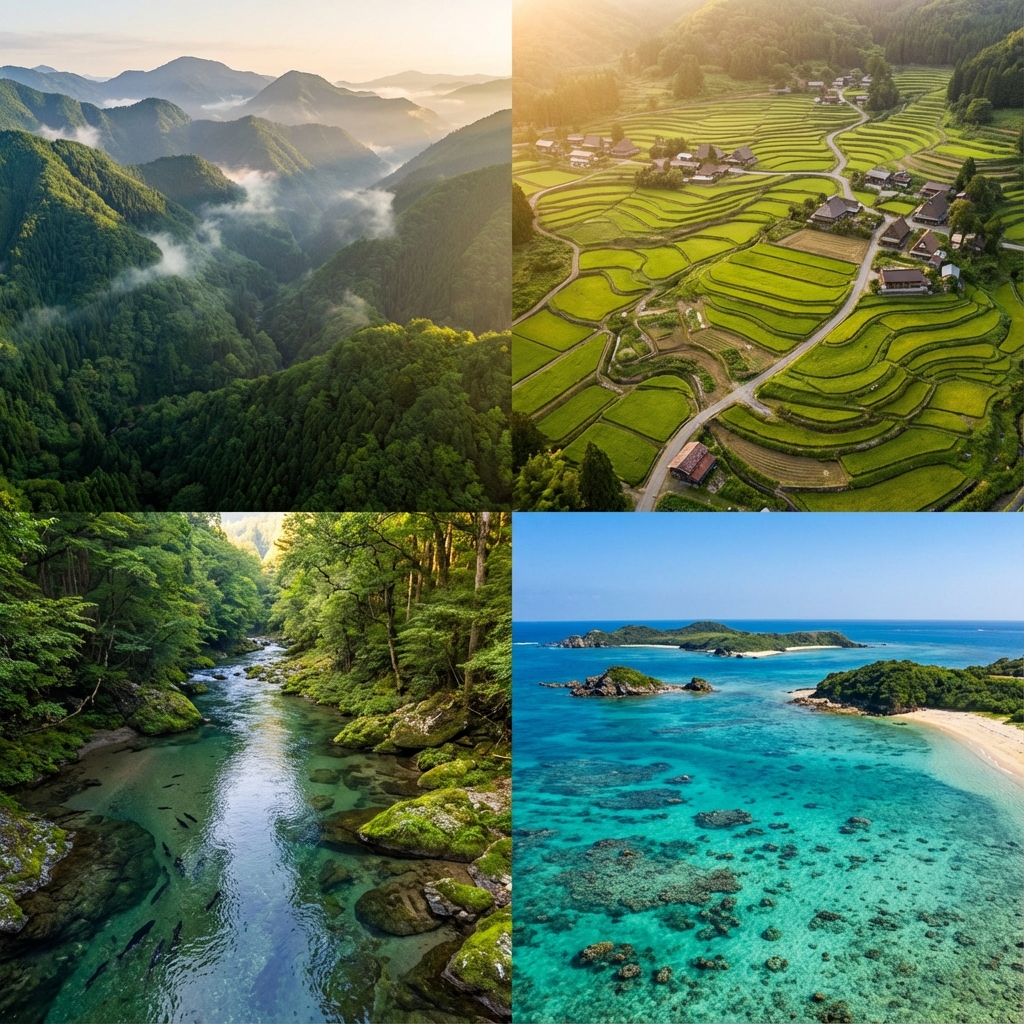
Japan as a "Biodiversity Hotspot"
Surprisingly little known, Japan is an extremely biodiversity-rich country by global standards. The Ministry of the Environment and international organizations have designated the "Japanese Archipelago" area, including Japan, as one of only 36 "Biodiversity Hotspots" in the world.
Why Is Japan Special?
- 3,000 km North-South Territory: Diverse climate zones from subtropical Okinawa to subarctic Hokkaido
- Complex Terrain: Mountains cover 70% of the land, creating countless independent ecosystems
- Island Nation Isolation: Separated from the continent, many "endemic species" have evolved uniquely
- Four Distinct Seasons: Different ecosystem services manifest with each season
Remarkable Numbers
- Endemic Species Rate: About 40% of terrestrial mammals and about 80% of amphibians are endemic to Japan
- Plants: About 30% of approximately 5,600 vascular plant species are endemic
- Insects: Estimated over 30,000 species (with many still undiscovered)
How the World Views Japan
The COP10 (Nagoya) Legacy
In 2010, Japan hosted the Conference of the Parties to the Convention on Biological Diversity (COP10) in Nagoya. The "Aichi Targets" adopted there guided global biodiversity policy for over a decade.
As the host country, Japan declared its position as a leader in global biodiversity conservation.
The SATOYAMA Initiative
The most influential concept Japan has shared with the world is "SATOYAMA."
The idea of "secondary natural environments where humans and nature coexist" differs from the Western approach of "protecting untouched wilderness," presenting a new paradigm to the world: "nature that becomes richer through appropriate human involvement."
Deployed internationally through the United Nations University as the "Satoyama Initiative," it is also applied to rural development in developing countries.
Branding Opportunities for Japan
Tourism: Ecotourism Potential
As the next phase after "Cool Japan," "nature experiences" are gaining attention.
- Yakushima's Primeval Forests: World Heritage recognition
- Shiretoko's Wildlife: Brown bears, Steller's sea eagles, etc.
- Okinawa's Coral Reefs: World-class diving spots
- Satoyama Rural Landscapes: "Japanese-ness" popular with foreigners
Business: Nature Positive Economy
In the context of TNFD and GBF, Japanese companies' "approaches to nature" are attracting global attention.
- Toyota's "Toyota Forest" (corporate satoyama conservation)
- Sekisui House's "5 Trees" Plan (native species planting in residential areas)
- Suntory's "Living with Water" (watershed forest conservation)
The Challenge: "Not Being Known"
Japanese People Don't Know Themselves
The biggest challenge is that Japanese people themselves don't know the value of Japan's biodiversity.
- No awareness of being a "Biodiversity Hotspot"
- Don't know the names of familiar creatures
- Tend to think environmental issues = overseas problems (Amazon, Savanna)
Data Shortage
Even if we say "Japan's nature is wonderful," there is insufficient data to prove it. Expert surveys alone cannot cover the vast territory.
What IKIMON Can Do
IKIMON is a platform that solves this "not being known" challenge.
1. Japanese People Rediscovering Japan's Nature
Insects found during walks, flowers blooming on commutes. The experience of learning their names and discovering "it was actually a rare species" nurtures affection for Japan's nature.
2. Citizens Creating Data
Filling data gaps that experts alone cannot keep up with through citizen power. IKIMON's data becomes foundational material for communicating Japan's biodiversity to the world.
3. World-Class Quality
IKIMON adopts GBIF-compliant international standard data formats. Collected data can be directly referenced by researchers worldwide.
Make all of Japan a Nature Coexistence Site. And communicate Japan to the world as a "Biodiversity Nation."That is the future IKIMON envisions.
References
- Conservation International. Biodiversity Hotspots.
- Ministry of the Environment, Japan. National Biodiversity Strategy.
- United Nations University. Satoyama Initiative.